

Fikri Muhammad Abdillah

Web applications. Realtime systems.

Scroll to explore

Fikri Muhammad Abdillah

Web applications. Realtime systems.

Based in Malang, Indonesia, my focus is TypeScript across web and realtime applications and agentic workflow tooling, with the public repositories in that space open to read.

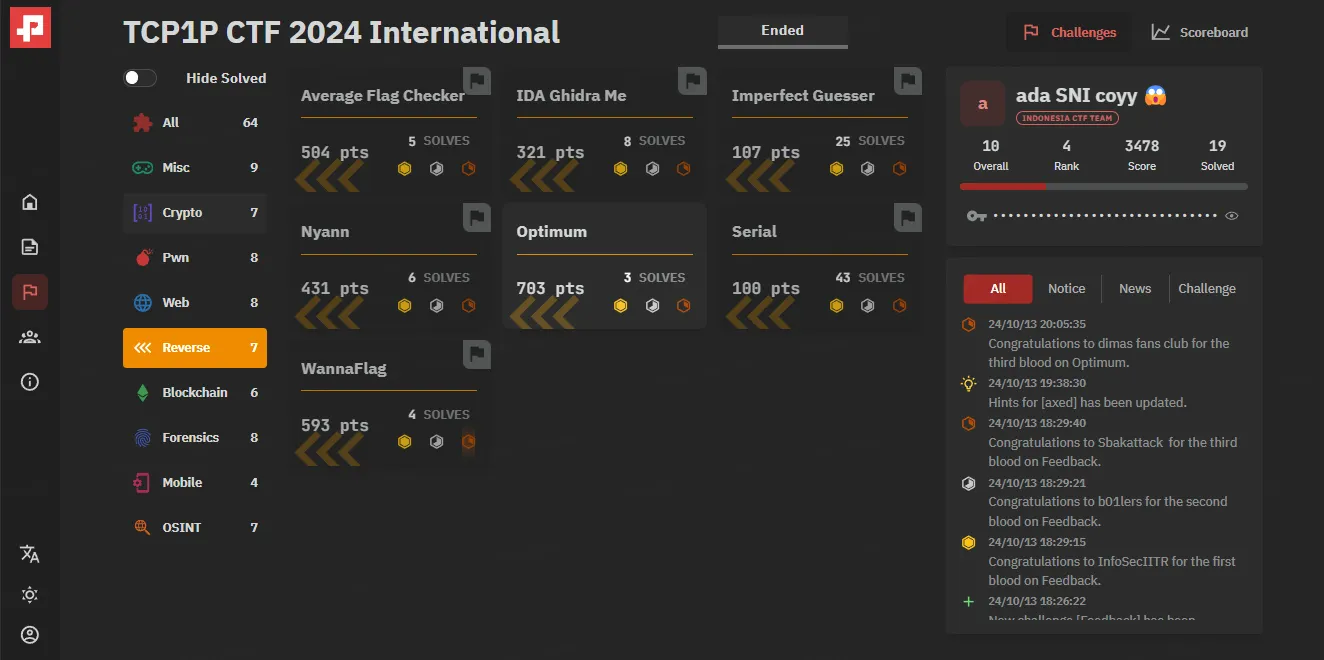
Capture the flag is where I keep learning — cryptography, digital forensics, reverse engineering, binary exploitation and smart-contract security — kept as notes rather than presented as professional security work.

Selected work

01 / Work

Look inside the work.

Three public repositories. Different systems, with the source material open to inspection.

Source study / 01

packages/

  • game-core Gameplay state transitions
  • dictionary Loading & normalization
  • shared Client/server protocol schemas
WordyChain AGENTS.md / source-derived visual

Source-derived visuals. Not product screenshots.

  1. WordyChain

    Realtime and web boundaries, kept visible.

    Source study / 01

    packages/

    • game-core Gameplay state transitions
    • dictionary Loading & normalization
    • shared Client/server protocol schemas
    WordyChain AGENTS.md / source-derived visual
    webrealtimeshareddictionarygame-core

    Public project structure separates realtime, web, shared, dictionary, and game-core packages; unit-flow, end-to-end, and package-level test directories are visible.
  2. JMC

    A documented web application stack.

    Source study / 02
    Local port 3000
    Application judgemycode-app
    Database judgemycode-db postgres:15-alpine
    JMC docker-compose.yml / source-derived visual
    Next.jsTypeScriptPostgreSQLPrismaDocker

    JMC documents a Next.js and TypeScript application with PostgreSQL/Prisma, NextAuth.js, Tailwind CSS, Bun, Docker, and sandboxed multi-language code execution.

  3. harness-agentic-sdlc

    Workflow governance for agent-driven delivery.

    Source study / 03

    Request complete

    1. 01 request
    2. 02 classify
    3. 03 workflow
    4. 04 inspect
    5. 05 plan/specify
    6. 06 approve
    7. 07 implement
    8. 08 validate
    9. 09 review
    10. 10 CI
    11. 11 deployment approval
    12. 12 deploy
    13. 13 verify
    14. 14 complete
    harness-agentic-sdlc README.md / source-derived visual
    TypeScriptCLIYAML workflowsMission ControlJSON output

    A repository-local harness publishes a request-to-deploy lifecycle with structured workflows, approval and CI evidence, a Mission Control projection for multi-feature work, and machine-readable output.

03 / Profile

Evidence over claims.

A curated record of publicly visible projects and learning material. Open a record for the evidence and its limits.

  1. TypeScript web applications
    Observed evidence
    TypeScript web and realtime application structure is publicly visible across WordyChain, JMC, and the harness-agentic-sdlc workflow tooling.
    Qualification
    Public repositories establish hosted project material, not individual proficiency level, employment history, or sole authorship.

    Source WordyChain ↗JMC ↗harness-agentic-sdlc ↗

  2. Modular application design with automated tests
    Observed evidence
    WordyChain visibly separates realtime and web applications from shared, dictionary, and game-core packages, with unit-flow, end-to-end, and package-level tests; OOT-AI-Agent-Practice pairs a Java store with JUnit 5 tests and a business-rule verifier.
    Qualification
    Visible project structure and tests do not establish authorship of every component.

    Source WordyChain ↗OOT-AI-Agent-Practice ↗

  3. Project-specific web-stack exposure
    Observed evidence
    JMC documents Next.js App Router, TypeScript, PostgreSQL/Prisma, NextAuth.js v5, Tailwind CSS v4, Bun, Docker, Piston-backed code execution, and multiple submission languages.
    Qualification
    This is JMC’s documented stack, not a personal proficiency claim; the README says the project was written by AI.

    Source JMC ↗

  4. Agentic SDLC workflow tooling
    Observed evidence
    harness-agentic-sdlc publishes a TypeScript CLI and repository-local governance: a request-to-deploy lifecycle, structured YAML workflows, approval and CI evidence, a Mission Control projection, and machine-readable JSON output.
    Qualification
    This describes the project’s documented capabilities, not verified personal authorship, adoption, or production use.

    Source harness-agentic-sdlc ↗

  5. Security-learning archive
    Observed evidence
    A public cybersecurity archive spans cryptography, digital forensics, reverse engineering, binary exploitation, and smart-contract security, drawn from many CTF platforms and paired with supporting tools and cheatsheets.
    Qualification
    A learning archive, not professional security work, a certification, or production security responsibility.

    Source Cybers_security ↗

  6. Reconciled professional and competition profile
    Observed evidence
    The LinkedIn Source Profile lists an engineering role at Six Zenith Digital, study at Politeknik Negeri Malang, and active Capture The Flag participation; the linked CTFtime profile records competition teams and published writeups since 2023.
    Qualification
    Profile-stated and self-reported; not independently verified, and not a claim of seniority, employment terms, or professional security responsibility.

    Source LinkedIn ↗CTFtime ↗

04 / Archive

Still learning. Keeping the notes.

A public CTF-oriented archive spans cryptography, digital forensics, reverse engineering, binary exploitation, and smart-contract security.

Drawn from many competition platforms and paired with supporting tools and cheatsheets.

Learning material, not professional security experience.

05 / Contact

Let’s talk.

Explore the source, connect on LinkedIn, or send a note directly.