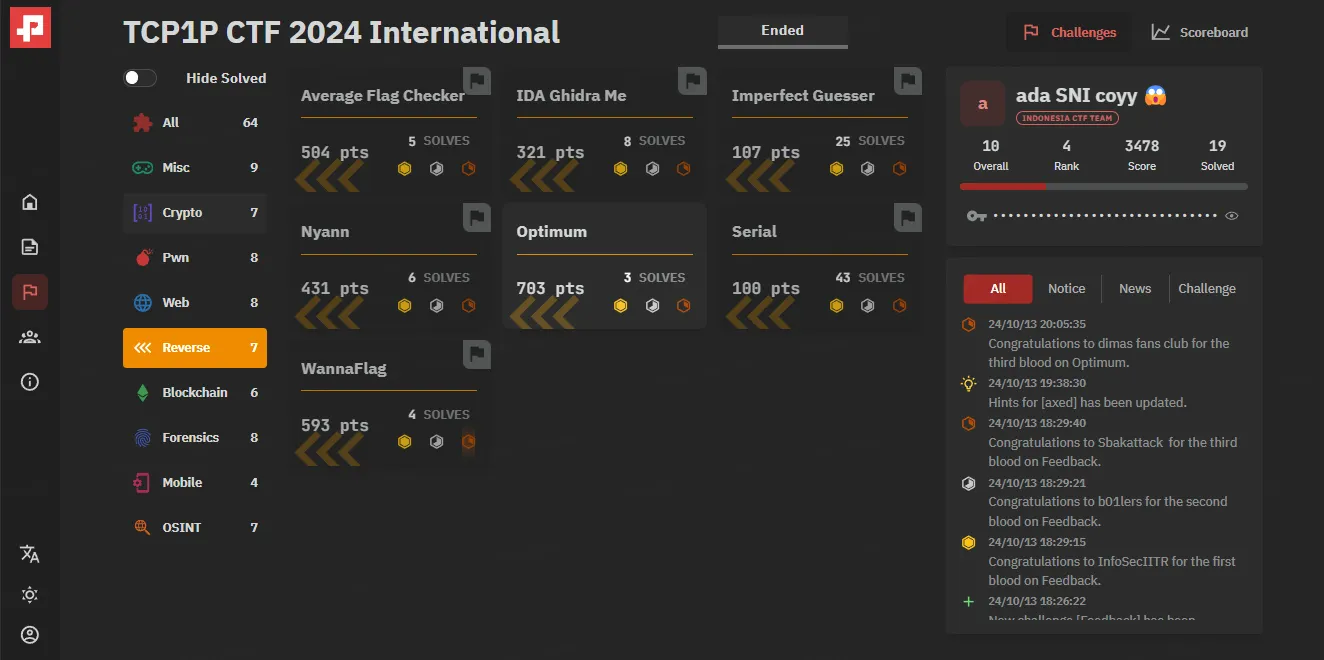
TCP1P International 2024 ran for two days in October, and I played it with team Serikat Newbie Indonesia. We finished 10th overall and 4th among Indonesian teams; my part was five reverse-engineering challenges. They are collected here in the order the writeup presents them — cheapest first — because that order is also the story: each one asks for a different kind of attention, and the last one asks for all of them at once.
The five solves
Rev / Serial
100 ptsA .NET licence window that will not accept a serial you have not built yourself.
dnSpy plus a debugger break lands on the real entry point; the serial is reconstructed from the name hash the checker expects, and that serial is also the AES key that decrypts the flag.
Full writeup for Rev / SerialRev / IDA Ghidra Me
321 ptsA binary whose functions return early, so both IDA and Ghidra show you a fraction of main.
The real control flow is split into chunks behind lea / push / retn separators; replacing them with NOPs restores the function, which then decompiles into an RC4-style keystream over a fixed ciphertext.
Full writeup for Rev / IDA Ghidra MeRev / Nyann
431 ptsA challenge that ships NekoVM bytecode instead of a native binary.
The .n file is bytecode for the neko virtual machine, so the work moves from disassembly to reading what the VM is asked to do with the flag.
Full writeup for Rev / NyannRev / Average Flag Checker
504 ptsA flag checker that resists the decompiler and gives up only when you read the assembly.
When the pseudocode will not produce a main function, the solve is to stop asking for it: follow the assembly by hand until the comparison the checker makes is visible.
Full writeup for Rev / Average Flag CheckerRev / WannaFlag
593 ptsTwo documented encryption layers, and a third one that only runs when the program crashes.
The visible layers are padded AES-ECB and an XOR pass, but the real final layer lives in a Structured Exception Handler that mutates the buffer a byte at a time; reimplementing that handler as a decoder produces the flag.
Full writeup for Rev / WannaFlag
What the set has in common
None of these are broken by a single trick. Each one is broken by noticing that a tool is telling you a smaller story than the binary is: a decompiler that stops at the first return, a virtual machine standing between you and the code, an exception handler that only runs when the program is already failing. The work is to find the layer the tool leaves out, then read it on its own terms.
The full posts keep the screenshots and the solver listings, which is why each challenge links out to Medium rather than being reproduced here.